Shortwave Radio Log Book: A Practical Tool for Enthusiasts and Content Creators
If you have ever spent an evening scanning the airwaves, twisting the dial on a shortwave receiver, and hoping to catch a signal from a distant continent, you already know how addictive the hobby can be. But if you have also tried to remember later which frequencies you found, what time you heard that broadcast, or whether the signal was clear or fading, you know the problem. A shortwave radio log book solves that problem in a straightforward way. It gives you a dedicated space to record the details that matter most, so you can look back, compare notes, and build a personal record of the signals you have caught.
For people who make or sell low-content books on platforms like Amazon KDP, the shortwave radio log book also represents a practical niche product. It is the kind of interior that helps a publisher offer something genuinely useful to a specific audience without needing to write a full manuscript. Whether you use it for your own logging or as a product you customise and sell, this type of log book fills a real need.
What a Shortwave Radio Log Book Offers
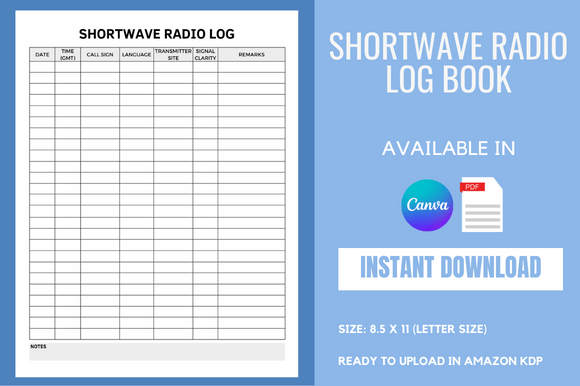
A shortwave radio log book is essentially a structured notebook designed for recording radio reception details. Each page typically includes spaces for the date and time of reception, frequency, station name or call sign, language, signal strength, and notes on audio quality or content. Some versions also include columns for the type of modulation, antenna used, or propagation conditions. The goal is to make logging consistent and easy, so you spend less time organising your notes and more time actually listening.
For the person selling the log book on KDP, the interior is ready to upload. The file comes as a PDF with 110 pages, sized 8.5 by 11 inches with bleed settings included. An editable Canva template link is also provided, so you can customise the layout, add your own branding, or tweak the column headers to fit a specific audience. This saves hours of formatting work because you do not have to build the pages from scratch.
Where and When People Use a Shortwave Radio Log Book
The shortwave radio log book is not something you use every single day, but when you need it, nothing else works as well. Here are some of the most realistic scenarios where a log book becomes genuinely valuable.
During evening listening sessions at home
Many shortwave enthusiasts do most of their listening after sunset, when atmospheric conditions make long-distance reception more reliable. You might be sitting in a home office, a living room corner, or even a basement workshop with a radio on the desk. As you tune through the bands, stations pop up at different frequencies. Without a log book, you might jot notes on scrap paper or try to remember the settings. With a structured log, you record each catch immediately. Later, you can compare which times of night produced the clearest signals from different regions.
While travelling or camping
Shortwave listening is a popular activity for people who spend time in remote areas where local radio stations are scarce. If you are camping, staying in a cabin, or travelling through regions with limited internet access, a portable shortwave receiver and a log book become your window to the outside world. You can log stations you pick up from distant countries, note the best times for reception, and create a travel log that becomes a personal record of your trip.
During emergency preparedness drills
Some people keep a shortwave radio as part of their emergency kit. When cell towers are down or the internet is unavailable, shortwave broadcasts can provide news and weather updates from government stations or international broadcasters. A log book helps you track which frequencies are active during an emergency, what times updates are transmitted, and which signals remain reliable. This is not a theoretical scenario. People who live in areas prone to hurricanes, earthquakes, or severe storms often rely on this kind of preparation.
In educational settings
Teachers and educators who run electronics clubs, radio enthusiast groups, or geography lessons sometimes use shortwave listening as a hands-on activity. Students can log stations from different countries, note the languages they hear, and learn about radio wave propagation. A log book designed for shortwave makes the activity structured and easy to manage, even for a group of beginners.
Different Users and How They Benefit
The shortwave radio log book is not a one-size-fits-all product. Different people get different things out of it, depending on their goals and habits.
Hobbyist listeners are the most obvious audience. They enjoy the hunt for distant stations and the satisfaction of logging a new country or frequency. For them, a log book is a personal archive. Over months and years, they can see how their reception patterns change with the seasons, solar activity, and changes in broadcast schedules. The 110-page format gives them plenty of room to accumulate entries without needing to buy a new book every few weeks.
Content creators and publishers on KDP see the log book from a different angle. They are not using it to log radio signals themselves, but as a product they can sell to hobbyists. Using the editable Canva template, they can change the cover design, adjust the interior layout, or add a custom branding page. This allows them to create a unique product in a niche that already has demand. Because the interior is already formatted with bleed settings and standard trim size, they avoid the common formatting errors that cause KDP rejections. That saves time and frustration.
Small business owners who sell radio equipment or related accessories can use a branded log book as a value-add for customers. If you run an online store selling shortwave receivers, antennas, or headphones, including a matching log book as a bundled item or a low-cost upsell makes sense. Customers appreciate having a purpose-built tool that complements their new equipment, and the business owner benefits from an additional product line without having to develop a complex new item.
Bloggers and content creators in the radio hobby space might use the log book as a giveaway, a lead magnet, or a printable resource for their audience. By customising the Canva template with their own logo and colour scheme, they can offer something tangible that builds connection with their readers. A downloadable PDF version also works well as a bonus for newsletter subscribers.
Practical Examples of How the Log Book Works in Real Life
Let me give you a concrete scenario. Imagine you are a hobbyist living in the Pacific Northwest. You have a basic shortwave receiver and you like to listen in the evenings after dinner. One night in January, you pick up a station broadcasting from Argentina at 9:15 PM on 11760 kHz. The signal is clear but has some fading. You write the details in your log book. Two weeks later, you hear another station from Brazil on a similar frequency. You check your log and see the previous entry. That pattern helps you understand that certain bands open up to South America during winter evenings in your location. Over time, your log book becomes a reference that helps you predict when and where to listen.
Now consider the KDP publisher who wants to create a variation of the log book for a niche audience, say, ham radio operators who also listen to shortwave broadcasts. Using the editable Canva template, the publisher adds columns for call signs, grid squares, or repeater frequencies. The basic layout stays the same, but the headers change to match the needs of a slightly different audience. This takes maybe 30 minutes in Canva, compared to designing a whole interior from scratch which could take several hours.
Or take the example of a small business selling portable shortwave radios at outdoor gear shops. They brand a log book with their company name and a rugged-looking cover. They offer it as a free bonus with every radio purchase. Customers see it as a thoughtful addition, and the business builds brand recognition every time the customer uses the log book.
What to Consider Before Using or Buying a Shortwave Radio Log Book
Before you jump into using a shortwave radio log book, whether for personal logging or as a product you plan to sell, there are a few practical factors worth thinking through.
Your listening habits matter. If you only listen to shortwave occasionally, a 110-page log book may last you years. That is not a problem, but you should be aware of the size. If you prefer a smaller notebook for portability, you might want to look for a version with fewer pages or a different trim size. However, if you are a regular listener who fills several pages a week, the 110-page format gives you longevity without needing to buy a new book every month.
Customisation requires basic Canva skills. The editable template is a huge time saver, but you do need to be comfortable enough with Canva to make changes. You do not need to be a graphic designer, but you should know how to edit text, change colours, and export the file as a PDF. If you have never used Canva before, expect to spend a short session learning the basics before you start customising.
Check the bleed settings carefully. For KDP interiors that use bleed, the PDF must include content that extends beyond the trim line. The provided file already has the correct bleed setup, so if you are simply uploading it as-is, you are fine. If you customise the template, make sure you do not accidentally shift elements into the safe zone. KDP can reject files with margin errors, so double-check before uploading.
Think about your audience. If you are selling the log book, understand who your buyers are. Shortwave listeners are often detail-oriented people who appreciate clear, functional layouts. They do not want flashy graphics that distract from the logging columns. Keep the design clean and readable. The template already follows this principle, so resist the urge to over-decorate.
Consider offering multiple versions. Because the template is editable, you can create different interiors for different segments. For example, one version aimed at beginners with simpler columns, and another for advanced users with extra fields for antenna type, propagation notes, or QSL card information. This strategy works well on KDP, where having multiple related products can increase your overall visibility in search results.
Connecting Features to Real Outcomes
When you look at what this shortwave radio log book interior offers, the real value is not in the file itself, but in what it helps you achieve.
- The 110-page count means you or your customers can log hundreds of reception sessions without needing a replacement. That matters for serious hobbyists who accumulate entries quickly.
- The editable Canva template means you can create a custom product without design experience. That matters for KDP sellers who want to stand out in a competitive marketplace.
- The 8.5 x 11 inch size provides enough space to write comfortably without cramping your handwriting. That matters for anyone who has tried to use a small notebook for logging and found it frustrating.
- The bleed-ready PDF eliminates a common technical hurdle when uploading to KDP. That matters for publishers who have struggled with formatting rejections in the past.
- The ready-to-upload format saves hours of manual layout work. That matters for anyone who values their time and wants to focus on marketing or content creation rather than page design.
None of these features are flashy. They are practical, functional, and aimed at solving real problems that people encounter when they either want to log radio signals or sell a product to those who do.
Final Thoughts on Using a Shortwave Radio Log Book
A shortwave radio log book is one of those tools that seems simple until you start using it, and then you wonder how you managed without it. For the listener, it turns a casual hobby into a structured practice where each session builds on the last. For the content creator or small business owner, it opens up a niche that has a ready audience and requires no heavy writing or design work.
If you are a hobbyist, grab a log book, sit down with your receiver, and start logging. The first few entries might feel routine, but after a month, you will have a record that tells a story about the signals you found, the conditions you faced, and the places you connected with across the airwaves.
If you are a publisher, the opportunity is straightforward. The interior is done. The template is editable. The niche exists. Your job is to add a cover, write a product description that speaks to shortwave enthusiasts, and upload it. From there, the market will tell you whether the product resonates. Given how many people still actively listen to shortwave radio around the world, the odds are good that a well-presented log book will find its audience.